 Brand Banao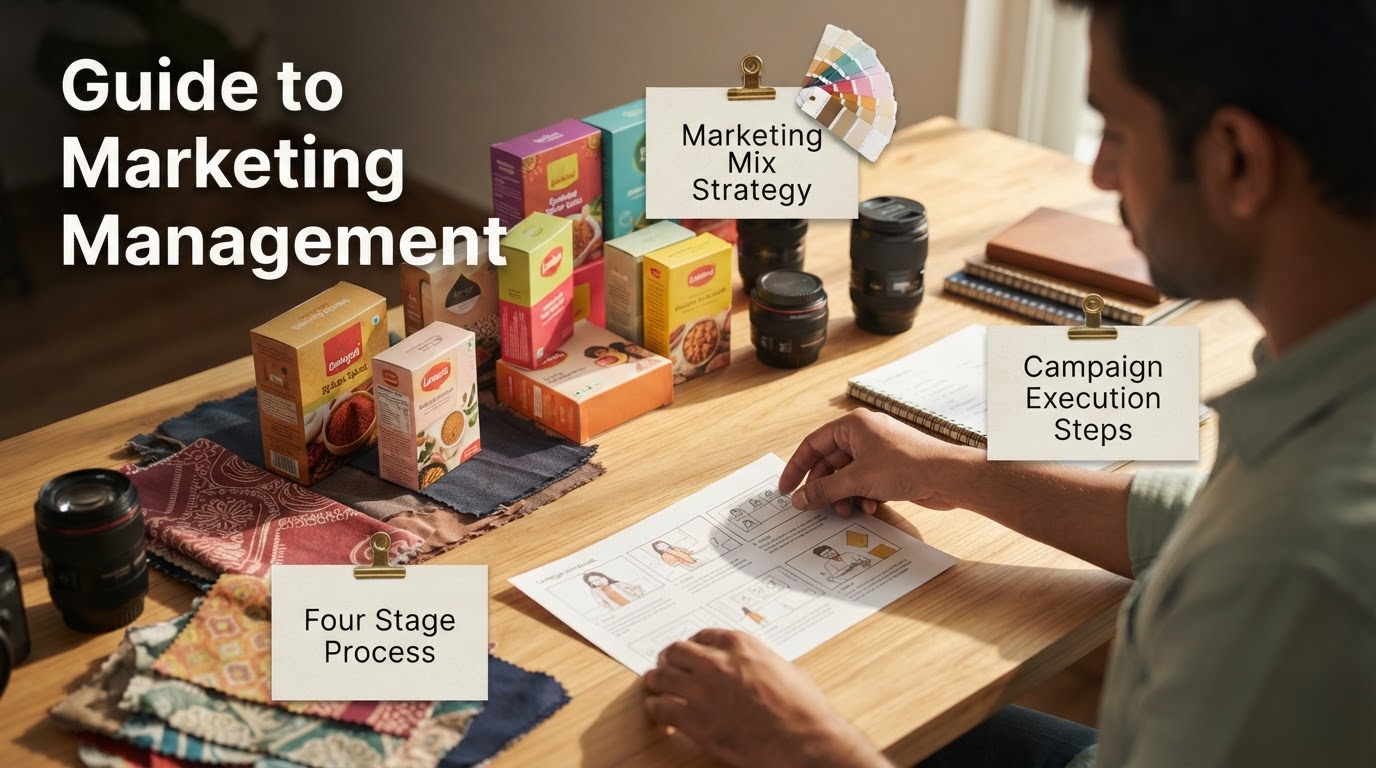
Marketing Management: Core Principles, Process, and Practical Execution Guide
Understanding Marketing Management: Definition and Core Purpose
Every commercial enterprise relies on connecting products or services with individuals who need them. Before exploring how leadership coordinates these efforts, it is vital to establish a clear baseline marketing definition. Marketing is the organizational function and set of processes designed to create, communicate, deliver, and exchange offerings that provide meaningful value to customers, clients, partners, and society at large. It is not merely advertising or direct selling; it is the systematic identification of human needs and the development of solutions that fulfill those requirements sustainably.
Building upon that foundation, what is marketing management? Marketing management represents the practical application, planning, coordination, and administrative oversight of an organization's marketing resources and activities. While marketing defines the broad activity of value creation, marketing management establishes the systems, leadership rhythms, and operational controls that make those activities viable, predictable, and profitable. It ensures that customer research translates directly into product improvements, promotional programs reach their intended audiences efficiently, and organizational capital produces measurable business returns.
Many practitioners confuse marketing strategy with marketing management. While closely linked, they serve distinct operational functions across different planning horizons. Marketing strategy defines the conceptual direction: which target segments to serve, what value proposition to highlight, and how to position against competitors. Marketing management takes that strategic blueprint and handles the day-to-day implementation, cross-functional resource allocation, budget stewardship, and campaign monitoring required to make the vision a reality.
The comparison below highlights the primary differences between high-level strategy and managerial execution.
| Dimension | Marketing Strategy | Marketing Management |
|---|---|---|
| Core Focus | Long-term market positioning, target audience selection, and commercial value proposition | Operational orchestration, resource allocation, and campaign execution |
| Time Horizon | Multi-year vision and annual strategic priorities | Daily, weekly, monthly, and quarterly operational cycles |
| Key Responsibilities | Identifying market opportunities, analyzing competitors, and shaping brand vision | Assigning team deliverables, managing ad spend, coordinating vendors, and resolving bottlenecks |
| Primary Deliverables | Strategic plans, competitive audits, and audience personas | Operational roadmaps, creative briefs, performance dashboards, and post-campaign reviews |
Why Marketing Management Drives Sustainable Business Growth
A well-conceived product cannot succeed in an open market without structured marketing management. Many companies develop strong products yet struggle to build durable revenue pipelines because their promotional and customer acquisition initiatives operate in isolated silos. Effective marketing management acts as the bridge connecting product engineering, sales operations, and end consumers, transforming sporadic public attention into lasting commercial trust.
One of the central contributions of structured marketing management is the reduction of commercial risk through systematic market research. Without managerial oversight, businesses frequently deploy capital based on internal assumptions rather than empirical customer demand. By running structured market evaluations, surveying customer cohorts, and monitoring competitive movement, marketing managers ensure that resources flow toward validated opportunities. This analytical discipline helps teams identify shifting buyer preferences early, avoiding expensive product misalignments.
Furthermore, marketing management establishes an essential balance between brand positioning and immediate demand generation. Organizations often swing between two extremes: investing exclusively in brand awareness without tracking short-term conversions, or chasing short-term lead volume at the expense of brand equity. A disciplined managerial approach aligns these twin goals. It builds multi-tiered campaigns that capture immediate sales demand while simultaneously nurturing the underlying reputation, trust, and organic recall that lower customer acquisition costs over the long term.
Ultimately, marketing management provides commercial accountability. By establishing clear key performance indicators, tracking channel velocity, and supervising spending, management ensures that marketing functions as a predictable revenue engine rather than an uncontrolled cost center.
The 4-Stage Marketing Management Process
Executing marketing management reliably across quarters requires an iterative operational model. Rather than treating marketing as a series of disconnected campaigns, high-performing organizations run a structured 4-stage management cycle: analysis, planning, implementation, and control. Each stage feeds directly into the next, establishing a closed feedback loop that sharpens performance over time.
Stage 1: Market Analysis and Consumer Intelligence Every sound management cycle begins with rigorous situational assessment. The objective is to evaluate internal strengths and weaknesses alongside external market opportunities and threats. In this phase, marketing managers gather quantitative data (such as web traffic, conversion rates, and sales velocity) and qualitative data (such as customer interview feedback and competitive positioning). The primary deliverable from this stage is a clear situational diagnostic that details target buyer pain points, unmet market needs, and benchmark metrics against industry competitors.
Stage 2: Strategic Goal Setting and Target Planning Once the analysis defines the operating landscape, the planning stage establishes measurable targets and defines the operational path. Management translates broad corporate objectives into specific marketing key performance indicators, such as target acquisition volume, qualified lead thresholds, or customer retention benchmarks. During planning, managers segment the wider market, select target customer cohorts, define product positioning, and allocate budget across designated channels. Clear operational trade-offs are decided here to ensure marketing resources focus on the highest-yield initiatives.
Stage 3: Multi-Channel Implementation and Asset Execution Planning transitions into tangible action during the implementation stage. Marketing managers coordinate internal creative teams, external media vendors, copywriters, and developers to bring campaigns to life. This stage encompasses producing creative assets, setting up ad campaigns, configuring automated email workflows, publishing educational content, and launching distribution programs. The managerial emphasis here centers on timeline management, cross-functional collaboration, quality assurance, and brand guideline consistency across all touchpoints.
Stage 4: Performance Monitoring, Tracking, and Control Loops The final stage establishes operational control. Marketing initiatives require continuous oversight rather than passive observation. In this phase, managers track live campaign data against the benchmarks set during Stage 2. If a channel underperforms, budgets are adjusted or creative variations are deployed. Once a campaign concludes, managers conduct formal post-campaign reviews to evaluate return on investment, isolate channel inefficiencies, and document key operational takeaways. These analytical insights immediately serve as the analytical inputs for the next cycle's Stage 1, creating continuous compounding improvements across all marketing management activities.
Core Frameworks: The 4Ps Marketing Mix and Strategic Orientations
To manage marketing effectively, leaders rely on structured models that guide tactical execution and organizational alignment. The two most enduring frameworks in marketing management are the 4Ps marketing mix and the strategic orientations that shape corporate behavior.
The 4Ps marketing mix provides the operational foundation for bringing any commercial offering to market:
- Product: The tangible good or intangible service designed to satisfy customer needs. Marketing management ensures the product delivers core benefits, reliable packaging, clear warranties, and ongoing feature updates.
- Price: The monetary value assigned to the offering. Managers evaluate cost structures, competitor pricing, customer price sensitivity, and discounting strategies to establish price points that support both healthy margins and market adoption.
- Place: The distribution channels and logistical paths that make the product available to target buyers. This includes direct-to-consumer websites, retail partnerships, wholesale networks, and regional inventory logistics.
- Promotion: The multi-channel communication used to inform, educate, and persuade target audiences. Promotion integrates content marketing, search engine optimization, paid advertising, public relations, social media, and sales enablement.
Beyond managing the tactical mix, marketing management requires choosing a commercial philosophy. Historically, businesses have operated under five distinct orientations, evolving from product-centric manufacturing models toward modern customer-first frameworks.
| Orientation | Starting Point | Primary Focus | Execution Means | Primary Objective |
|---|---|---|---|---|
| Production Orientation | Factory and production floor | Production efficiency, high volume, and low unit costs | Mass manufacturing and wide distribution networks | Maximizing profits through high operational scale and low prices |
| Product Orientation | Research and development lab | Product engineering, feature richness, and technical superiority | Continuous product refinement and technical innovation | Driving adoption via perceived technical superiority |
| Selling Orientation | Existing warehouse inventory | Aggressive sales outreach, promotion, and outbound closing | High-pressure sales techniques and intensive advertising | Converting existing stock into revenue regardless of customer fit |
| Marketing Orientation | Target consumer market | Uncovering buyer pain points, preferences, and desires | Integrated, customer-first marketing programs and continuous research | Achieving sustainable profits by delivering superior customer satisfaction |
| Societal Marketing Orientation | Broad society and human ecosystem | Long-term human well-being, sustainability, and ethical impact | Socially responsible business practices, green supply chains, and transparent operations | Balancing consumer satisfaction, organizational profitability, and societal preservation |
Modern marketing management centers predominantly on the marketing and societal orientations. When internal operations align around genuine customer satisfaction and responsible practices, businesses build durable competitive advantages that transcend price competition.
The Modern Marketing Manager: Core Responsibilities and Competencies
The modern marketing manager serves as the central orchestrator of business growth, translating strategic vision into operational workflows. Rather than functioning solely as a creative specialist or a raw data analyst, an effective manager connects disparate disciplines, coordinating copywriters, designers, media buyers, product teams, and sales representatives around shared commercial targets.
Daily marketing manager responsibilities encompass several core disciplines:
- Strategic resource allocation and budget management across active channels.
- Managing cross-functional production schedules and sprint backlogs.
- Tracking campaign metrics and translating complex analytics into clear executive reports.
- Aligning marketing campaigns with sales pipelines to maximize lead conversion.
- Managing external agency partners, freelance contributors, and MarTech software stacks.
Executing these responsibilities requires a diverse skill profile. Leaders must combine hard analytical marketing skills, like campaign data interpretation, attribution tracking, and conversion rate optimization, with essential soft capabilities, such as stakeholder management, creative direction, and clear communication. Strong foundational marketing knowledge regarding consumer psychology, brand architecture, and distribution dynamics allows managers to make sound decisions without getting lost in daily tactical noise.
To structure these competencies systematically, modern organizations evaluate talent using the T-shaped marketer framework. Under this model, horizontal breadth represents baseline literacy across diverse channels and concepts, while vertical depth represents specialized expertise in one or two functional domains.
The framework below outlines how a modern marketing manager balances horizontal literacy with specialized operational depth.
| Competency Layer | Skill Domain | Practical Operational Application |
|---|---|---|
| Horizontal Breadth (The Top of the T) | Consumer Research & Persona Mapping | Conducting qualitative user interviews and analyzing market survey trends |
| Horizontal Breadth (The Top of the T) | Content Strategy & Brand Narrative | Crafting clear messaging guidelines, value propositions, and content themes |
| Horizontal Breadth (The Top of the T) | Data Analytics & Dashboard Literacy | Interpreting web analytics, funnel progression metrics, and attribution models |
| Horizontal Breadth (The Top of the T) | Channel Foundations (SEO, Social, Email) | Understanding basic search ranking factors, email delivery, and paid channels |
| Horizontal Breadth (The Top of the T) | Cross-Functional Project Management | Running agile campaign sprints, managing budgets, and scoping deliverables |
| Vertical Depth: Track A (Performance Depth) | Paid Media Acquisition & Bidding Models | Building complex multi-tier paid search and social campaigns with custom conversion tracking |
| Vertical Depth: Track A (Performance Depth) | Conversion Rate Optimization (CRO) | Designing statistical A/B tests on landing pages to systematically increase checkout rates |
| Vertical Depth: Track B (Brand & Content Depth) | Corporate Storytelling & PR Strategy | Orchestrating brand launches, major media placements, and industry positioning |
| Vertical Depth: Track B (Brand & Content Depth) | Organic Community & Retention Architecture | Building organic customer retention loops and loyalty programs to maximize repeat purchases |
Adopting this marketing T profile allows managers to understand the whole operational picture while providing deep technical leadership in their designated primary domains.
Step-by-Step: How to Plan and Run a Marketing Management Project
Executing a successful marketing management project requires a structured workflow that keeps cross-functional teams aligned from conception through post-campaign analysis. Without a clear project architecture, campaigns often suffer from scope creep, missed deadlines, inconsistent brand messaging, and unclear attribution.
To execute marketing campaigns predictably, teams can implement a standardized four-phase project lifecycle. The following hypothetical project execution framework illustrates how an organization can structure a major product launch or acquisition push from start to finish.
Phase 1: Project Charter and Scoping The campaign begins by establishing clear commercial boundaries and analytical targets before producing any creative collateral.
- Define core campaign objectives using concrete key performance indicators (such as acquiring 500 qualified leads or increasing trial sign-ups by 20 percent).
- Detail the target audience persona, primary customer pain points, and core value proposition.
- Establish total project budget caps, resource allocations, and primary channel selections.
- Build a project charter identifying the project owner, key contributors, external vendors, and final approval authorities.
Phase 2: Tactical Planning and Creative Briefing With the scope locked in, managers translate objectives into clear operational assignments.
- Develop detailed creative briefs outlining messaging requirements, brand voice guidelines, and asset specifications.
- Map the customer conversion journey from initial ad click through landing page interaction to post-conversion email sequences.
- Establish tracking parameters, including custom URL campaign tags, conversion tracking pixels, and CRM lead routing rules.
- Finalize production schedules, milestone delivery dates, and cross-functional review checkpoints.
Phase 3: Production, Quality Assurance, and Launch Execution This phase manages creative development, platform configuration, and live launch execution.
- Produce all required campaign assets, including ad copy, banner graphics, video collateral, and custom landing pages.
- Execute end-to-end quality assurance testing across desktop and mobile devices, validating that form fields, tracking pixels, and automated emails trigger properly.
- Conduct pre-launch alignment reviews with sales teams to prepare them for inbound lead volume.
- Deploy campaign assets simultaneously across designated channels according to the launch schedule.
Phase 4: Post-Launch Monitoring, Optimization, and Review The project lifecycle concludes with disciplined evaluation and continuous refinement.
- Monitor early campaign delivery data during the initial 48 to 72 hours, confirming spend velocity and tracking integrity.
- Run structured mid-campaign optimizations, reallocating spend away from lower-performing ad variants toward high-performing segments.
- Execute a formal post-campaign retrospective, comparing final performance metrics against original targets.
- Document operational insights, channel benchmarks, and creative learnings in a shared repository to guide future marketing management project lifecycles.
Marketing Management Quick-Reference Notes & FAQs
For business owners, team leads, and practitioners seeking quick revision, the following marketing management notes summarize core concepts, operational terms, and fundamental commercial performance formulas.
| Concept or Metric | Operational Definition | Practical Calculation or Formula |
|---|---|---|
| Customer Acquisition Cost (CAC) | Total sales and marketing capital required to win a single new paying customer over a given period | CAC = Total Sales and Marketing Costs / Number of New Customers Acquired |
| Customer Lifetime Value (LTV) | The total gross margin or net revenue a business anticipates generating from a single customer relationship over time | LTV = Average Order Value x Purchase Frequency x Average Customer Lifespan |
| Return on Ad Spend (ROAS) | A performance metric measuring gross revenue generated directly for every currency unit spent on paid advertising | ROAS = Gross Campaign Revenue / Direct Advertising Cost |
| Marketing ROI | High-level commercial profitability metric evaluating overall marketing investments against net revenue gains | Marketing ROI = (Gross Profit Generated - Total Marketing Cost) / Total Marketing Cost x 100 |
| 4Ps Marketing Mix | The operational combination of Product, Price, Place, and Promotion used to capture market share | Continuous operational calibration across the four levers |
Frequently Asked Questions
How does marketing management differ from sales management? Marketing management focuses on identifying broad customer needs, building brand awareness, and generating qualified interest across wider market segments. Sales management takes over those qualified leads, managing individual customer relationships, pipeline negotiations, and closing contracts.
What role do artificial intelligence and modern marketing technology tools play in marketing management? Modern marketing tools automate routine operational tasks, such as email scheduling, bid management, predictive audience segmentation, and performance reporting. However, marketing managers still direct strategic positioning, creative alignment, budget stewardship, and ethical governance.